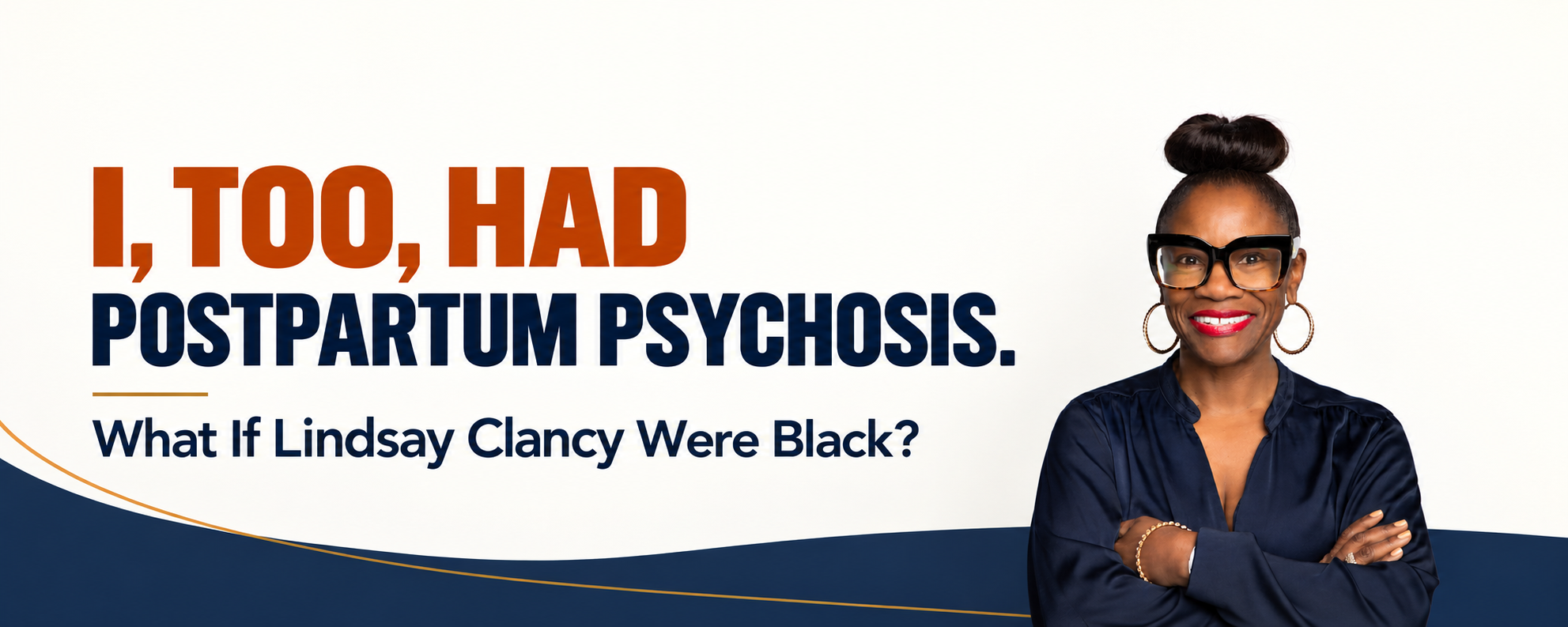
I had postpartum psychosis. I’ve never shared that publicly in this way before.
I had only heard of postpartum depression and I was not depressed. For me, it looked like fear—extreme, irrational, consuming fear that someone else was going to hurt my daughter. But I always had a plan.
What postpartum psychosis looked like for me
I became hypervigilant about protecting her. I saw threats where there were none. I obsessed over protective measures and created escape and rescue plans. On my worst night, I became convinced that someone was going to come into my apartment and harm her. I stayed awake all night, sitting outside her nursery, guarding my baby with two spray bottles I had filled with bleach, prepared to use them against an intruder who was very real to me but existed only in my mind.
The very next day, sensing that what had happened was not okay, I wrapped my baby up, drove into Manhattan to Columbia University, where I was a graduate student, walked into the mental health services office and put myself into therapy.
I got help. Thankfully, therapy and family support worked for me.
But I know what it means for a postpartum brain to betray you. I know what it means for something to feel terrifyingly real when it is not. That is why I am genuinely grateful for the compassion surrounding Lindsay Clancy and for the attention her case has brought to postpartum psychosis, psychiatric care and all the ways our systems can fail mothers in crisis. I am grateful that people are asking about her medical care, her medications, whether warning signs were missed and whether a mother can deeply love her children and still become profoundly mentally ill. (Note: Postpartum psychosis is a serious mental illness that can begin suddenly after childbirth. Symptoms may include delusions, hallucinations, severe confusion, paranoia, mania, depression and rapid mood changes. It is a psychiatric emergency requiring immediate care.)
But my gratitude is complicated by another reality.
That Black mothers have not historically been afforded this same curiosity, context, grace or collective protection in similar situations.
When white mothers are in crisis, we are often invited to ask: What happened to her? Was she overwhelmed? Did she get the help she needed? Who failed her?
When Black mothers are in crisis, the question too often becomes: What kind of mother does this? How do we punish her?
And I was already saying this four years ago.
The Lindsay Clancy case and the question of compassion
In September 2022, Erin Merdy walked her three children into the ocean at Coney Island, Brooklyn, and drowned them. CBS2 New York news called me as a maternal-health expert to help make sense of the tragedy. At the time, investigators were examining her mental health, including concerns about postpartum depression and reports that she was hearing voices. Like Lindsay, she was a mother of three. Erin’s youngest child was just three months old, so she was still very recently postpartum.
I told CBS that every mother can be at risk for postpartum mental-health disorders. I also warned that Black mothers are often over-penalized and criminalized and that our children are taken from us at disproportionate rates, which can make seeking help feel dangerous in ways it may not for other mothers.
Four months later came Lindsay Clancy, and America began paying a very different kind of attention to postpartum mental illness. Her case became a national reckoning over medical care, psychiatric treatment and whether someone who committed an unimaginable act could still be understood as a loving mother who had become gravely ill.
Today, Erin Merdy is serving 20 years to life in prison. She pleaded guilty to three counts of first-degree murder and was sentenced in May 2026. End of story.
There was no comparable public examination of whether the healthcare system had failed her, how illness may have distorted her reality, or how a woman who was described by those around her as loving and caring mother could commit an incomprehensible act.
And as I sought to support Erin’s family, there was another difference that became impossible to ignore: material solidarity.
Millions of dollars did not pour in for Erin. There was no army of donors, no high-powered legal team funded by public sympathy. Meanwhile, more than $2 million was raised in support of Lindsay and her family.
That matters, because there is sympathy, and then there is putting your money where your heart is.
I do not begrudge Lindsay Clancy or her family one dollar of that support. I am asking why that same instinct toward grace, advocacy and protection has been so much harder to summon for Black mothers.
The racial double standard facing Black mothers
Then there’s the case of Latarsha Sanders, a Black mother in Massachusetts whose trial was presided over by Judge William F. Sullivan—the same judge who later presided over Lindsay Clancy’s trial.
Sanders was convicted in 2022 of killing her two young sons and sentenced to life in prison without parole. Her lawyers argued that she was severely mentally ill and not criminally responsible for what she had done.
But there was on key difference.
In Sanders’ trial, Judge Sullivan prevented the jury from seeing extensive psychiatric records documenting her deteriorating mental health. In August 2026, the Massachusetts Supreme Judicial Court unanimously ruled that excluding those records was prejudicial error, threw out her convictions and ordered a new trial.
I hope America’s same supportive energy and generosity is present for Sanders’ retrial.
Because in that first trial, Sanders’ prosecutor described her to jurors as “evil” and accused her of “playing the crazy card.”
Sit with that language for a moment.
One mother’s mental illness became something to investigate, contextualize and understand.
The other mother’s claim of mental illness was literally described to jurors as a “crazy card.”
This is not merely a theoretical discussion about racial bias in motherhood. In this instance, the contrast played out in the same courthouse, before the same judge.
If you need more data, the disparity in perception has been well documented.
A 2026 peer-reviewed study in the Journal of Public Child Welfare examined 60 high-profile maternal filicide cases from 1983 through 2025 and found that African American mothers were predominantly portrayed through narratives of criminality and moral failure, often with mugshots and little systemic context, while white mothers were more often framed around mental illness, stress and sympathetic explanations.
A 2024 Harvard Journal of Law & Gender article looked specifically at Lindsay Clancy alongside Black mothers including Erin Merdy, Dimone Fleming, Aleah Newell and Paulesha Green-Pulliam. Its argument was strikingly similar: Clancy was more readily treated as someone “worth saving,” while women of color received far less sympathetic framing.
Black women have been saying this too, on social media and in Black media. I need everyone to listen. (Please read: Why A Black Woman Has Never Raised $2 Million Dollars After Killing Her Children)
Because this double standard did not begin with postpartum psychosis. It is rooted in a much older story about Black motherhood in America.
From slavery, when our children could literally be taken from us and sold, Black mothers have lived under extraordinary scrutiny and with far less room to struggle, fail or simply be human. For generations, Black women were deemed perfectly capable of caring for white people’s children—first by force and later, too often, by limited economic opportunity—while somehow being cast as incapable of properly caring for our own.
Make it make sense.
That contradiction survived slavery. It reappeared in the welfare-queen mythology, in punitive child-welfare systems and perhaps most viciously during the crack cocaine era, when Black women suffering from addiction were turned into symbols of maternal depravity. Pregnant women were drug tested, reported to authorities, prosecuted and separated from their children. In some places, hospitals effectively became extensions of the criminal legal system.
The message was clear: when Black mothers struggled, our struggle was treated not as evidence that we needed help, but as evidence that there was something fundamentally wrong with us. And we have been trying to do it all, often by ourselves or without tapping into available support, ever since.
I remember recognizing that double standard more than 20 years ago when I was writing my MochaManual.com blog for Black mothers. In April 2004, I watched an episode of The Oprah Winfrey Show in which a group of white mothers talked openly about drinking wine to cope with the pressures of motherhood.
I remember writing that if a group of Black mothers had gone on national television and admitted that they needed alcohol to get through motherhood, some of us might have had Child Protective Services waiting for us before we got home from the studio.
It was a joke.
Except it wasn’t.
“Wine mom” eventually became a cultural identity. Today, mothers openly discuss cannabis as a way to relax, unwind or cope with the stresses of parenting. White mothers have always had “help,” including Black women and other women of color who did their care work and house work to lighten their load.
And to be clear, I am not interested in judging any mother for needing help, a break or even a crutch. My point is about who is allowed to have one without forfeiting the presumption that she is still a good mother.
Black mothers carry a very different history of what can happen when we admit that we are struggling.
And we still see echoes of that history in far too many Irth app reviews and in the stories Black mothers share every day: the feeling that we enter healthcare spaces under suspicion, that we are presumed irresponsible or deficient and must somehow prove that we are good mothers. White mothers are more readily afforded the opposite presumption—that they are good mothers who may be overwhelmed, exhausted, sick or in need of help.
That distinction matters.
Because the false narrative about Black motherhood, rooted in white supremacy, still shapes whose failures are interpreted as evidence of illness and whose are interpreted as evidence of character.
So perhaps the real question is this:
Who gets the benefit of being seen as a good mother who became ill, and who is simply seen as a bad mother who finally revealed herself?
What Black Mothers Deserve
I know firsthand how dramatically the postpartum mind can change. I am reliving pieces of my own nightmare even as I write this, and I am thankful for the thousands of women who have raised their hands in this moment to say, Me too.
That attention matters, and it must continue. Maternal-health advocates have been demanding better policy, better support and better care during the postpartum period for years. I literally wrote a book called The Big Letdown. The system has been failing mothers and families after birth for far too long, and it must do better.
So I will never argue for less compassion for Lindsay Clancy. She absolutely deserves compassion, context and recognition of the reality of severe mental illness.
But as we extend that compassion to Lindsay—and as Latarsha Sanders heads toward a new trial—I want us to keep asking a harder question:
Which mothers do we instinctively believe deserve to be understood? Who is worthy of compassion and context?
Not as an excuse for what happened, but as a recognition of our shared humanity. And as a recognition that mental illness is real.
Lindsay Clancy absolutely deserves that humanity.
I am simply saying, Black mothers do too.
In Motherhood,
Kimberly
———————————–
If this essay changed how you think about postpartum psychosis, race and who receives compassion, please share it!
Black mothers deserve to be heard, believed and protected. Your story is data and it can help inform or protect the next mother. Share an anonymous review of your prenatal, birth, postpartum or pediatric care experience on IRTH. It takes less than 10 minutes.
RESOURCES:
The National Maternal Mental Health Hotline: 1-833-TLC-MAMA (free and available 24/7)
The Shades of Blue Project: Online support groups and resources for maternal mental health for women of color.